History
Courtesy of the Carroll County Historical Society
Shimer College was founded in Mount Carroll, Illinois as the Mount Carroll Seminary, a non-denominational coeducational seminary. The charter for the seminary was granted by the Illinois General Assembly on June 18, 1852, after lobbying by the citizens of Mount Carroll.
Francis Wood (later Francis Shimer) and her friend Cindarella Gregory, arrived from New York and classes began on May 11, 1853 with 11 students in a single room in the Presbyterian Church in Mount Carroll. Enrollment rose in the course of the year; when the college formally opened in a dedicated building in 1854, there were 75 students.
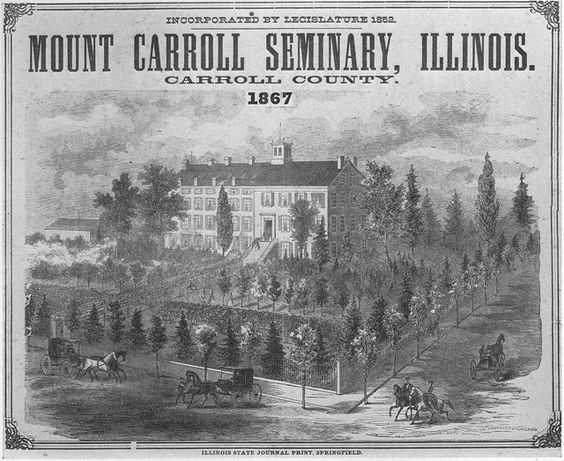
In 1855, fearing that the school would fail due to the lack of subscription revenue; the incorporators sold their shares in the college to the teachers, Wood and Gregory. This was arranged under favorable terms, with the land donated and the building sold at cost, on the condition that Wood and Gregory continue operating the school for at least 10 years. On February 25, 1867, the school was re-chartered by the state legislature to reflect the new arrangement.
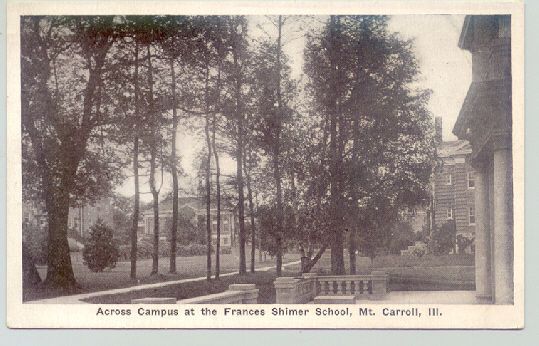
Throughout the 19th century the campus grew steadily from the original single building. By 1883, the campus covered 25 acres, much of it planted with trees. The music and arts programs were a significant attraction of the seminary. The seminary had the first piano in Carroll County. The music and arts programs remained strong even after the seminary became the Frances Shimer Academy in 1896.
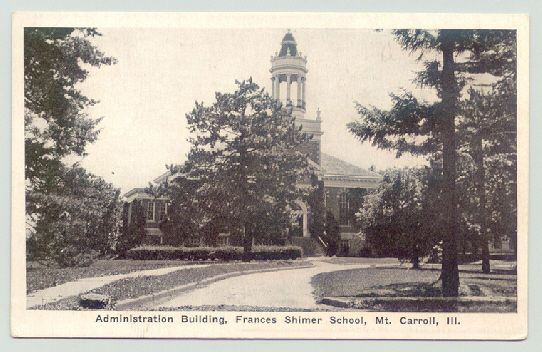
On December 22, 1857, Frances Wood married local naturalist Henry Shimer, who became a physician and also taught science classes at the seminary. He later became wealthy through real estate speculation. In 1896 Francis Shimer transferred control of the seminary to a Board of Trustees under an affiliation with University of Chicago. Academics were kept to University of Chicago Standards. New construction on the campus of South Hall, Dearborn Hall for music and Hathaway Hall were added. In 1906 fire destroyed much of the campus. An emergency fundraising drive was launched to rebuild the campus with more modern and fireproof brick buildings. In the 1940’s, the college faced difficulties with both enrollment and finances. By 1949, enrollment had fallen to 65 students and the college was in debt. Shimer underwent a major reorganization in 1950. In the reorganization Shimer took on its current name, and became a Great Books school. Shimer remained officially classified as a junior college until it was accredited as a four-year college by the North Central Association in 1959.
Administration problems, falling enrollment in the 1960’s and 1970’s led to the decision to move the school. The Mount Carroll campus was purchased by the Restoration College Association, a group of Mount Carroll residents who wished to prevent the campus from being broken up. It later became the site of the Campbell Center for Historic Preservation Studies.
The transition from abandoned college to Campbell Center took many years. The site was administered by Restoration College Association, which changed its name to the Campbell Center for Historic Preservations Studies in the mid-1980’s and in 1990 the Campbell Center’s first director began developing a curriculum devoted to historic preservation. During the interim period, the beautiful site was used for a number of activities.
The Campbell Center offered professional development coursework to meet the training needs of those working in collections care and historical preservation. Uncertainty set in 2017 and in April 2018, the closing of the sale of the International Preservation Studies Center prompted the community to question what was going to happen to the campus. By invitation, GROWTH and its Board of Directors toured the site in June 2018, taking title of the campus on December 31, 2018.
Shimer College was founded in Mount Carroll, Illinois as the Mount Carroll Seminary, a non-denominational coeducational seminary. The charter for the seminary was granted by the Illinois General Assembly on June 18, 1852, after lobbying by the citizens of Mount Carroll.
Francis Wood (later Francis Shimer) and her friend Cindarella Gregory, arrived from New York and classes began on May 11, 1853 with 11 students in a single room in the Presbyterian Church in Mount Carroll. Enrollment rose in the course of the year; when the college formally opened in a dedicated building in 1854, there were 75 students.
In 1855, fearing that the school would fail due to the lack of subscription revenue; the incorporators sold their shares in the college to the teachers, Wood and Gregory. This was arranged under favorable terms, with the land donated and the building sold at cost, on the condition that Wood and Gregory continue operating the school for at least 10 years. On February 25, 1867, the school was re-chartered by the state legislature to reflect the new arrangement.
Throughout the 19th century the campus grew steadily from the original single building. By 1883, the campus covered 25 acres, much of it planted with trees. The music and arts programs were a significant attraction of the seminary. The seminary had the first piano in Carroll County. The music and arts programs remained strong even after the seminary became the Frances Shimer Academy in 1896.
On December 22, 1857, Frances Wood married local naturalist Henry Shimer, who became a physician and also taught science classes at the seminary. He later became wealthy through real estate speculation. In 1896 Francis Shimer transferred control of the seminary to a Board of Trustees under an affiliation with University of Chicago. Academics were kept to University of Chicago Standards. New construction on the campus of South Hall, Dearborn Hall for music and Hathaway Hall were added. In 1906 fire destroyed much of the campus. An emergency fundraising drive was launched to rebuild the campus with more modern and fireproof brick buildings. In the 1940’s, the college faced difficulties with both enrollment and finances. By 1949, enrollment had fallen to 65 students and the college was in debt. Shimer underwent a major reorganization in 1950. In the reorganization Shimer took on its current name, and became a Great Books school. Shimer remained officially classified as a junior college until it was accredited as a four-year college by the North Central Association in 1959.
Administration problems, falling enrollment in the 1960’s and 1970’s led to the decision to move the school. The Mount Carroll campus was purchased by the Restoration College Association, a group of Mount Carroll residents who wished to prevent the campus from being broken up. It later became the site of the Campbell Center for Historic Preservation Studies.
The transition from abandoned college to Campbell Center took many years. The site was administered by Restoration College Association, which changed its name to the Campbell Center for Historic Preservations Studies in the mid-1980’s and in 1990 the Campbell Center’s first director began developing a curriculum devoted to historic preservation. During the interim period, the beautiful site was used for a number of activities.
The Campbell Center offered professional development coursework to meet the training needs of those working in collections care and historical preservation. Uncertainty set in 2017 and in April 2018, the closing of the sale of the International Preservation Studies Center prompted the community to question what was going to happen to the campus. By invitation, GROWTH and its Board of Directors toured the site in June 2018, taking title of the campus on December 31, 2018.